How to Memorize the Quran Online: The Definitive Hifz Guide (2026)
A comprehensive blueprint for Muslim students and working adults seeking to become a Hafiz of the Holy Quran through 1-on-1 online tutoring. Discover the classical Al-Azhar methodology, daily retention routines, and neuroscience-backed memory techniques that prevent forgetting.
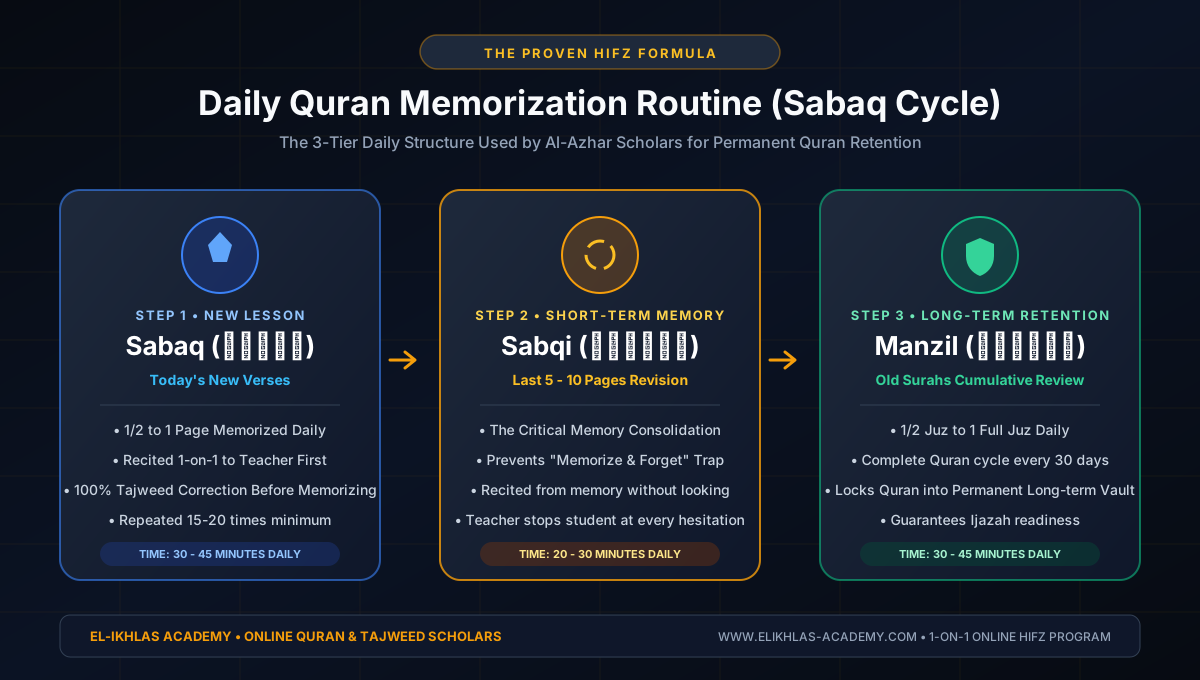
Table of Contents: In-Depth Guide
- 1. Why Online Quran Memorization is Outperforming Traditional Madaris
- 2. The Golden 3-Tier Formula: Sabaq, Sabqi, and Manzil Explained
- 3. Step-by-Step Daily Routine for Working Adults & Students
- 4. The 4 Biggest Memorization Traps (And How to Defeat Them)
- 5. Hifz Timelines: 2-Year vs 3-Year vs 5-Year Completion Benchmarks
- 6. Frequently Asked Questions (Parent & Adult Inquiries)
1. Why Online Quran Memorization is Outperforming Traditional Madaris
For generations, the dream of memorizing the Holy Quran required enrolling full-time in an overseas boarding Madrasah or attending crowded local weekend centers. For Muslims living in the United States, the United Kingdom, Canada, and Europe, this often posed major disruptions to secular academics, family life, and career obligations.
Today, 1-on-1 live online Quran memorization has revolutionized Hifz education. Modern cloud technology pairs students directly with elite Egyptian scholars graduated from Al-Azhar University—the undisputed global capital of Quranic sciences.
Unmatched 1-on-1 Focus
In a traditional classroom with 20 students, each student recites to the teacher for merely 2 to 3 minutes. In our 1-on-1 online classes, 100% of the session is dedicated solely to your recitation, Tajweed nuances, and memory checks.
Zero Travel Time, Total Safety
Parents no longer lose 4 to 6 hours weekly sitting in traffic during evening rush hours. Students learn in the calm, familiar comfort of their own home, with parents freely listening in on lessons.
2. The Golden 3-Tier Formula: Sabaq, Sabqi, and Manzil
The primary reason students struggle or abandon their Hifz journey is not a poor memory—it is the absence of an organized revision system. The Arabic proverb famously states: "The Quran is more prone to escape than camels tied with ropes."
Sabaq (السبق): The New Verses
This is the brand-new portion of verses assigned for today (ranging from half a page for beginners to one full page for advanced students).
- Golden Rule: Never memorize a verse until your teacher listens to you recite it with 100% Tajweed accuracy. Memorizing an error cements it into your subconscious mind.
- Repetition target: Recite the verse looking at the text 15 to 20 times, then test yourself looking away 10 times.
Sabqi / Amokhta (السبقي): Recent Verses (Last 5 to 10 Pages)
This is the revision of the verses memorized over the preceding 5 to 14 days. These verses are in transition from short-term memory to long-term synaptic retention.
- Recited entirely from memory to your online tutor before new Sabaq is heard.
- If more than 2 hesitations or mistakes occur in Sabqi, the teacher halts new lessons to solidify the foundation.
Manzil / Dhor (المنزل): Old Surahs Cumulative Review
This encompasses all previously completed Juz and Surahs. Without consistent Manzil, older Surahs inevitably fade away.
- Students review half a Juz to one full Juz every single day.
- Ensures the entire memorized Quran is recycled and refreshed every 20 to 30 days throughout your life.
3. Step-by-Step Daily Routine for Working Adults & Students
You do not need 6 hours of empty time to memorize the Quran. The most accomplished online Hifz graduates succeed through micro-habits distributed strategically across the day:
Morning (Fajr Time - 25 mins): The Absorption Window
The mind is free from daily mental fatigue. Dedicate this slot exclusively to memorizing your new Sabaq. Recite aloud with focused breathing and visual immersion on the Mushaf page.
Midday / Commute (15 mins): Audio Deep-Immersion
Listen to your assigned page recited on repeat by a master Qari (such as Sheikh Mahmoud Khalil Al-Husary or Sheikh Minshawi) while driving, commuting, or taking a break.
Live Online Lesson (30-45 mins): 1-on-1 Correction & Audition
Connect on Zoom with your certified Al-Azhar Sheikh. You recite your Manzil first, then Sabqi, and finally present your new Sabaq. Your tutor checks every vowel, stopping point, and subtle Tajweed rule.
Night (Before Sleep - 15 mins): Sleep Consolidation
Recite tomorrow's prospective page 5 times before falling asleep. Neuroscience demonstrates that memory rehearsal prior to sleep activates neuro-plastic consolidation during REM cycles.
4. The 4 Biggest Memorization Traps (And How to Defeat Them)
Trap 1: Switching Between Different Mushafs
Your brain uses spatial photographic memory. If you memorize from a 15-line Madinah Mushaf today and switch to a 13-line or South Asian script tomorrow, you break your visual anchor. Rule: Use only ONE standard Mushaf copy throughout your journey.
Trap 2: Rushing to Finish Without Revision
Memorizing 2 new pages daily without reviewing old Juz produces a "paper Hafiz"—as soon as you reach the end, the beginning has vanished. Revision must always occupy at least 60% of your study time.
Trap 3: Neglecting Similar Verses (Mutashabihat)
The Quran contains over 2,000 verses that share identical or near-identical wording across different Surahs (e.g., Al-Baqarah vs Aal-Imran vs Al-A'raf). Our tutors supply specialized Mutashabihat mnemonic drills to master them.
Trap 4: Memorizing in Silence Without Vocal Recitation
Silent reading only activates your eyes. The Quran is an oral tradition. Reciting in a resonant, moderate voice engages your vocal cords, auditory cortex, and muscle memory simultaneously.
5. Hifz Timelines: 2-Year vs 3-Year vs 5-Year Completion Benchmarks
Compare our structured online memorization pathways to choose the pace that harmonizes with your school, career, or family schedule:
| Program Track | Daily Target | Weekly Commitment | Total Duration | Best Suited For |
|---|---|---|---|---|
| Intensive Fast Track | 1 full page / day | 5 sessions (60 min each) | 2 to 2.5 Years | Homeschooled children, gap-year students |
| Balanced Core Track (Most Popular) | 1/2 page / day | 3-4 sessions (45 min each) | 3.5 to 4 Years | School kids, university students, working parents |
| Flexible Executive Track | 3 to 5 lines / day | 2 sessions (30-45 min each) | 5 to 6 Years | Busy executives, senior citizens, non-native beginners |
Online Quran Memorization FAQs
Expert answers regarding study schedules, revision techniques, and tutor qualifications.
Yes, hundreds of busy professionals in the USA and UK complete their Hifz online through structured part-time schedules (30 to 45 minutes daily, 3 to 4 times per week). The key is consistent daily revision (Manzil) rather than memorizing huge chunks at once.
Was this Quran Guide helpful?
Your feedback helps us refine our academic curriculum and guides for Muslim families worldwide.
Related Quran & Tajweed Master Guides
Best Online Quran Classes for Kids: Complete Parent Guide
1-on-1 interactive lessons, certified Al-Azhar teachers, and Noorani Qaida roadmap for children.
Best Online Tajweed Classes & Rules: A Complete Beginner's Guide
Makharij al-Huruf, 4 rules of Noon Sakinah & Tanween, and Madd lengths with Egyptian scholars.
Learn Noorani Qaida Online: Step-by-Step Guide for Kids & Beginners
From zero Arabic to reading the Holy Quran in 90 days via the 17-lesson Haqqani syllabus.
Explore Our Accredited 1-on-1 Online Courses
Choose the specialized track that fits your age, goals, and daily schedule.
Authoritative Scholarly Citations & Global References
For educational authenticity and academic verification, our curriculum adheres strictly to standards established by globally recognized Islamic institutions and canonical resources:
Book Your 2 Free 1-on-1 Hifz Trial Lessons
Connect with an authentic certified Al-Azhar Hafiz scholar. Get a complimentary recitation evaluation and a personalized Quran memorization plan tailored to your daily schedule.